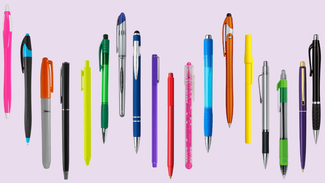
This is a safe space to admit that you’ve never really thought that much about pens or pen-related terminology.
If you don’t know the difference between a rollerball and a ballpoint, or how click pens work, or why some pens have caps, you’re in the right place. We’re here to break down the key terminology we use to describe our promo pens, so you can shop knowing you’re getting exactly what you want, but mainly so you can show off any time the opportunity presents itself.
Types of Pen Ink
Pen ink is weirdly important when you’re shopping for pens. This is not just because you probably have a preference (even if you don’t know it yet) but because it’s the ink type, not the mechanism, that determines what we call different types of pen.
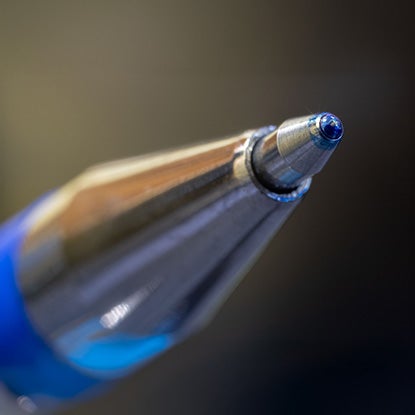
The most common types of pen today are rollerball, ballpoint, and gel. All of them use the same basic ink-delivery system: a reservoir of ink above a metal ball in a socket. (Reservoir really just means the cartridge.) When you move the pen across the page, the ball rolls, pulling ink from the reservoir onto the paper. Before Hungarian inventor László Bíró perfected this system sometime around 1938, everyone had to use annoying leaky fountain pens.
Since they all write in the same way, these pen types are named after the ink they use. Rollerball and ballpoint pens both use dye inks, and gel pens use pigment inks.
Dye vs Pigment
Prepare to really impress your pen nerd friends. Or to make pen nerd friends!
Pen ink is made up of three main components:
-
1
The colorant: yes, the thing that gives the ink color
-
2
The vehicle: the liquid that carries the colorant
-
3
Binding agents: chemicals that bind the vehicle with the colorants, and the ink with the paper
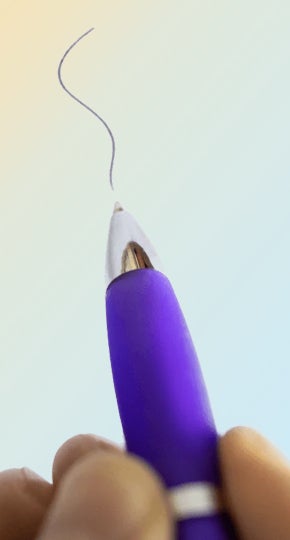
Most inks either use dye or pigment colorants. In dye inks, the colorant is dissolved inside a liquid (aka the vehicle, but I’m not calling it that, it sounds like it’s getting in a car.) Imagine pouring Kool-Aid into water: the water itself changes color. In rollerball pens, that liquid is water-based. In ballpoint pens, the liquid is oil-based.
In pigment inks, the colorant doesn’t dissolve: it’s suspended inside the liquid (the vehicle, fine.) It’s the same way milk works – it’s why milk can separate into curds (the fatty parts) and whey (the watery parts.) When you write, the colorful pigments sit on top of the paper while the liquid can absorb into it.
Choosing Ink Types
Now you know all this, you can choose pens based on the final effect you’re going for. If you think about your favorite pen, what do you like about it? Do you like that it flows easily, or that it’s never dry, or that it has a strong color? That comes down to the qualities of the ink.
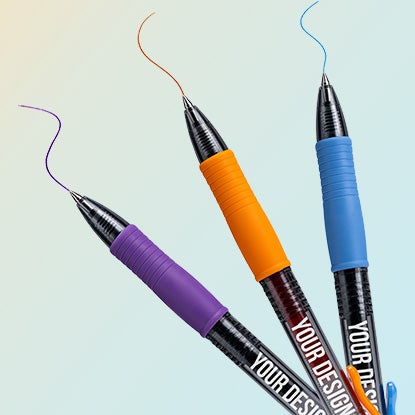
Pigment inks – like in gel pens – tend to come in more saturated colors, because the colorant isn’t diluted. The gel in gel pens is usually water-based, to create a smoother flow, but unlike water-based dye inks, gel pen ink is water-resistant or even waterproof. That’s thanks to the pigment ink being insoluble in water, and also to strong binding agents that stick the pigment to the paper. Pigment inks are also less prone to fading in sunlight. However, the pigment and liquid can separate over time, and the pigment can clog your pen if you don’t clean it regularly, preventing ink from flowing.
This maintenance requirement is why most pens tend to use dye inks, even though they fade faster. Dye inks don’t build up so you don’t have to clean your pens, and the whole ink absorbs into the page, not just the colorant, which leads to a more consistent color. And those colors can look brighter than pigment pens, because dye inks aren’t as dense and so reflect more light.
Rollerballs vs Ballpoints
You might be wondering, if rollerballs and ballpoints both have that ball mechanism, and they both use dye inks, what’s the difference between them? We did say up top that we would explain this, and it’s surprisingly simple: Rollerball pen ink is water-based and ballpoint ink is oil-based.
This is why rollerball pens flow smoothly across the page, whereas ballpoints can feel a bit sticky and require more pressure. On the pro-ballpoint side, oil is thicker than water, so it creates bolder lines. Oil also dries faster on the page, which reduces the risk of smudging, and it’s too thick to bleed through the paper. Ballpoint pens also don’t dry out when exposed to air. This is why pens that have retractable tips tend to be ballpoints, whereas pens with caps tend to be rollerballs or gel.
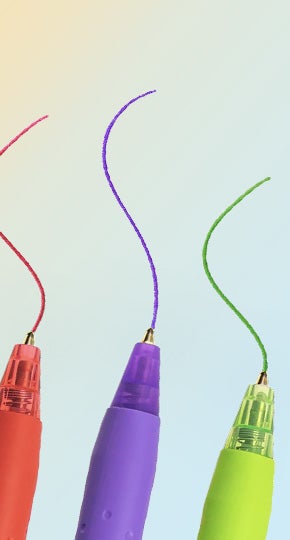
Hybrid Inks
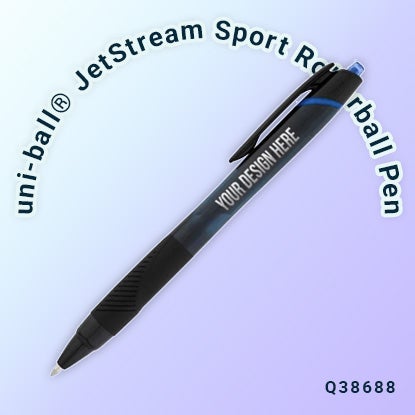
Some big dreamers have made inks that combine the benefits of pigment gel ink – saturated colors, nice flow, fade- and water-resistant – with the benefits of ballpoint ink – no clogging, quick-drying with no smudges – and rollerball ink – low viscosity. These get lumped together as hybrid inks and they tend to be proprietary formulae. For example, Uniball’s Jetstream ink is oil-based, like a ballpoint, with a low viscosity, like a rollerball, and uses pigments to create rich and lasting colors, like a gel pen.
Pen Mechanisms
Now we know what’s in the pen ink, let’s look at how it gets out of the pen. We’re going to start with capped pens and go in order of least to most complicated mechanism (and it might not be the order you expect.)
Capped
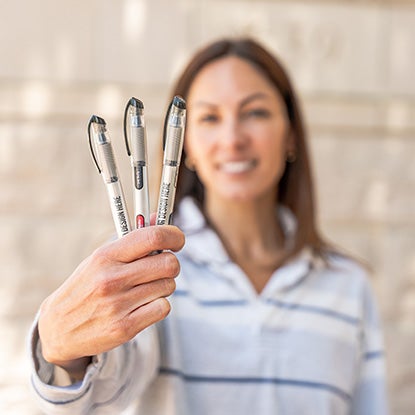
These pens always have the tip exposed (no giggling, this is a family-friendly article) and covered with a cap when not in use. You mostly see caps on pens with water-based inks (rollerball or gel) that dry out if left exposed to air, but some ballpoints use them too.
The most simple type of pen has an ink cartridge that is connected to a metal or plastic tip, which screws into a plastic barrel. Where the cartridge and tip connect is where you’ll find that tiny metal ball in a socket. The cap clicks or twists onto the barrel to protect the tip and ink.
Marker Pens
Markers, or felt tips, represent an interesting subset of capped pens. Yes, interesting: come on, you’re into this now! They’re interesting because they’re a commonly used pen that doesn’t use Bíró’s ball and socket to deposit ink.
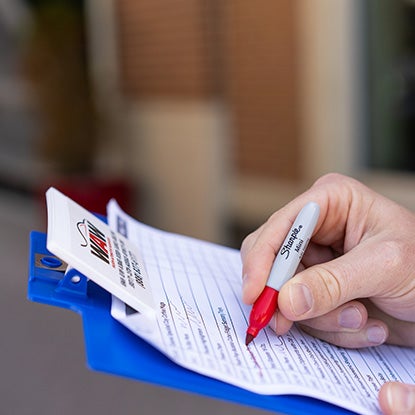
Markers work using the same principle as fountain pens, but without all that fiddly replacing of ink. Both types of pen rely on capillary action to move ink down to the tip at the perfect rate to write, without just flooding out everywhere. It works because when you get liquid in a narrow space, it follows two principles. The first, adhesion, means it sticks to the surface around it, and the second, cohesion, means the liquid molecules stick to each other. All of which combines into liquid molecules moving up the narrow space, in a gravity-defying motion.
Like those ball-and-socket pens, markers have a reservoir. However, instead of being a tube, it’s made of a spongy synthetic material that soaks up all the ink. The tiny holes in the sponge are the narrow spaces that create the capillary effect: The ink gradually pulls it way through these to the tip end of the pen. The tip is also made of a special material that holds ink when you aren’t pressing down, then releases it when you do.
Speaking of the ink, it’s usually water- or alcohol-based, so it dries really fast on the page (and really fast in the air if you leave the cap off.) Permanent markers specifically tend to be alcohol- or oil-based, but the permanence is really thanks to the bonding agents (resins in this case) which act like glue. The colorant is usually a pigment, rather than a dye, which is how you get those rich colors.
Retractable Pens
As you have undoubtedly figured out, retractable pens have tips that retract when not in use. There are two main types: ones that twist and ones that click.
Twist
In a twist I didn’t see coming, twist retractable pens are generally much simpler than click pens.
The bit you twist acts as a plunger that pushes down on the cartridge inside. (The cartridge is attached to the tip, with the metal ball and socket between them.) The plunger has a little notch that sticks out. Around the plunger is another piece that has a track this notch slots into. The track goes diagonally down and round the pen, like a stripe on a candy cane.
When you twist, the plunger is pushed down, which pushes down the cartridge, and the little notch is guided down and round. When it’s gone the whole distance of the slot, it locks into place, and the tip is now sticking out of your pen. When you twist the end back the other way, you twist the little notch up the slot, back to where it started.
There are other more complicated ways to do it, but that’s the simplest!
Click
If you thought that click pens worked with a simple plunger-spring mechanism, honestly, same, but no. There are multiple steps, but the short version is that there are three different components inside the top of the pen – the guide, the plunger, and the cam – that use a system of teeth and slots to create rotation, which allows the cam to push the cartridge down then release it so it bounces up (thanks to a spring near the tip.) Sometimes the guide and plunger are part of the same piece, but the mechanics are the same. Here’s a video that shows the whole process:
The Bottom Line
Isn’t it nice to know what all those pen words mean? And to be able to appreciate the engineering that goes into getting the tip out of the pen and the ink on the page? It’s also going to help you order promo pens that give your customers a great experience that reflects positively on your brand. And, yes, show off.
Natasha Lavender
Natasha is an experienced writer and editor who has covered topics including technology, health and safety, business, and pop culture. Her work has been published by Good Housekeeping magazine, Forbes, Success, and more.