We call them stress balls, but in fact, we make them in a genuinely impressive number of shapes. We’ve got buffalos, brains, houses, horses, peppers, peaches, and penguins. Suffice it to say, I strongly recommend thinking of a shape and then searching for it on our site – you’ll be surprised.
It’s the stress “ball” manufacturing process and the material we use that give us the flexibility to make so many different types. Here’s how your stress balls are mixed, molded, and made-up so they can make their way from our factories to your fist.
What Are Stress Balls Made From?
Before we get into the step-by-step, it’s a good time to explain polyurethane, i.e. the substance a lot of stress balls are made from.
Polyurethane (PU) is the name for a group of plastics used in an almost bizarrely wide-ranging variety of products. In addition to stress balls, you can get shoes and clothes made of PU (aka “vegan leather”), plus sponges, home insulation, car seats, flooring, and more. One of PU’s greatest strengths is that it can be relatively easily modified to be flexible or rigid for different purposes.

The PU used in stress balls is made by combining two chemicals (polymer polyols and liquefied modified MDI, if you’re interested) plus a catalyst, plus some stirring. The chemicals sit in separate tanks, and when the technician pulls the lever, the valves open, the chemicals flow into a central area where they get spun around, and then the resulting mixture is squirted into the hot mold.
It’s kind of like an ice cream machine with a tank of vanilla, a tank of chocolate, and a single spout. (By the way, room temperature liquefied modified MDI looks like chocolate syrup. If not dessert, why dessert shaped?) When you pull the lever, the two ice creams swirl together. When you stir them, they get all mixed into messy ice cream soup.
Unlike with ice cream, one of the byproducts of the PU reaction is carbon dioxide – the same stuff soda bubbles are made of. Just like you can feel your abdomen expanding when you’ve had a few colas, it’s those bubbles that make the foam expand. So basically, PU stress balls are tough, foamy plastic filled with air.
Stress Ball Mold
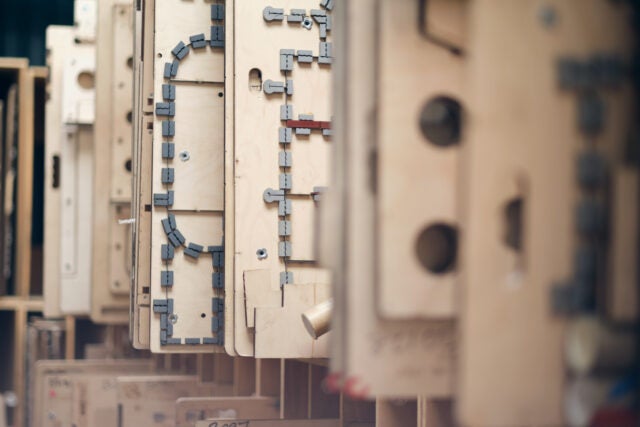
You can make a stress ball mold out of lots of different materials, including silicone and steel, but molds for mass-produced stress balls tend to be made of aluminum. It’s more durable than silicone molds, which are cheaper but wear out after less than 100 uses, compared to 50,000 to 100,000 uses of aluminum molds. And although steel molds can be used more than 100,000 times, they also cost around $10,000 to make, compared to $1,000 to $5,000 for aluminum molds.

Molds start out with a model made of clay, wax, or resin. These used to be sculpted by hand, but now are usually made by 3D printing digital designs. You cover the model with liquid aluminum, which gradually hardens to form your mold.
Before that, you might have to cut – or print – the model in two sections, divided at the widest point. Molds are typically made of two pieces connected by a hinge, which makes it easier to get the stress balls out. Picture those waffle makers they have in hotels that you have to rotate by hand! (This is going to be a dessert-heavy blog post.) The foam can leak through the narrow gap between each side, creating a little ridge called a seam, but you won’t even be able to see it in the final product.


You then make a sample stress ball. You can alter the density of the PU to make it more or less squishy: Check out our stress ball squish test to see this in action! Once you’re happy with the stress balls the mold is producing, that mold becomes the master tool – the mold all other molds are based off. It’s like how songs come from a master recording. (Which is why it’s so important to own your masters – ask your nearest Swiftie for more information.)
How many molds you need depends on how big you want your stress balls to be. The mold is always going to be roughly the same size, because someone has to turn it by hand. Imagine trying to turn a giant waffle maker! Since you can’t keep increasing the size of the mold, the way you can get more stress balls out of one mold is by having smaller stress balls. The more stress balls you can fit per mold, the fewer molds you need to make in order to hit your total required number of stress balls.
The Stress Ball Manufacturing Process

The Bottom Line
Most of our stress balls are made from polyurethane, an easily adaptable chemical that quickly turns from a liquid to a foam, expanding to fill specially made aluminum molds. The molds are coated with paint, and additional details are painted on by hand. So the stress ball on your desk was made through a combination of clever chemistry, machines, and careful handiwork. Don’t you feel more relaxed knowing that?
Natasha Lavender
Natasha is an experienced writer and editor who has covered topics including technology, health and safety, business, and pop culture. Her work has been published by Good Housekeeping magazine, Forbes, Success, and more.