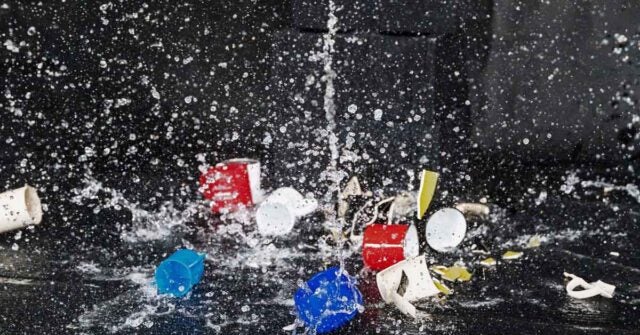
To help you pick between our bafflingly large selection of promo mugs, we decided it would help to show you what they’re made of (literally.)
A mug’s material determines its color, style, price point, and the kind of customization you can get, so it’s a good place to start. By the end of this article, you’ll know the difference between ceramic and enamel, what kind of glass we use, and what wheat is doing on this list. If you can handle it, let’s fill you in. Yes, that was the best mug joke I could come up with.
Ceramic
What It’s Made From

Ceramic is a broad term for an object or material made by heating a nonmetallic material – usually clay – at high temperatures. That could be the ancient vase on display at a museum (no touchy), your favorite promo mug, or the “elephant” that looks more like a toe five-year-old you made in a pottery class.
There are three main types of ceramic: earthenware, stoneware, and porcelain. The main differences between them are how much of various minerals they contain and how high they’re heated to during firing. Most mass produced promo mugs (like ours) are stoneware, which is fired at high temperatures (not as high as porcelain) to create a durable, non-porous ceramic.
The very important final step in making most ceramics is adding the glaze, which helps create a seal that keeps out water and adds color.
How It’s Customized
Screen printed, pad printed, full color sublimation printed
Best For
The mug that’s used every day.
Pros
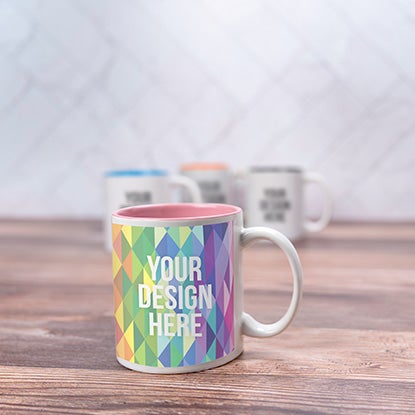
Well-made mass produced stoneware ceramics are very durable. Think of the coffee mug you’ve had for decades that’s still going strong. They’re generally dishwasher proof in the top rack, although you can make them last even longer by hand-washing them. They come in a wide range of colors and styles, and with more customization options than other materials: Your design can be screen or pad printed in one color, or printed in full color. They’re also good at keeping drinks warm, which is crucial.
Cons
When we carried out our Mug Drop Test, one out of six of our ceramic mugs broke when we dropped it from 44” (about 3.6’) onto hard concrete. Three broke when we dropped them from 74.5” (about 6’) – although three other ceramic mugs survived even that height. So stoneware ceramic isn’t indestructible, but it is pretty tough.
One thing that really affects how long your ceramic mug lasts is the glaze. A bad glaze that has gaps or wears away over time can allow water to get into the clay, causing cracks and even mold.
Enamel
What It’s Made From
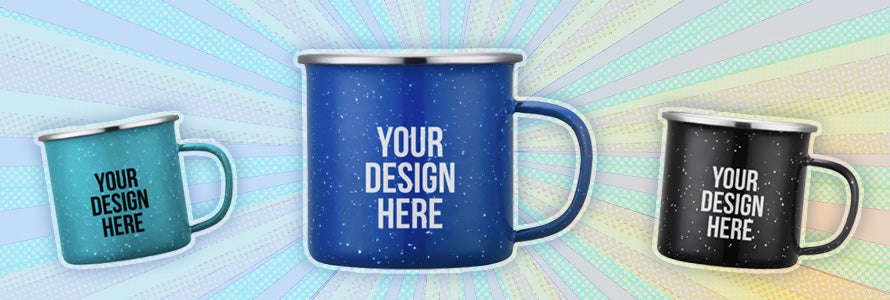
The mug part of enamel mugs is made of metal, typically steel or iron. The enamel part refers to the coating that’s added to the outside of the mugs, which is made of powdered glass mixed with a substrate and fused to the metal under super high temperatures. Enameling was invented to counter the metallic taste you get from drinking from a metal mug, and to prevent rust from the metal mug getting into the drink.
By the way, those speckles you often see on enamel cookware were inspired by a popular type of enamelware called graniteware, which originated in Germany in the 1700s and used a porcelain coating instead of powdered glass. Unfortunately, this turned out to break quite easily, but the speckles looked cool so other enamel makers started incorporating them into their designs. I think your next camping trip just got its best conversation starter.
How It’s Customized
Screen printed, full color printed
Best For
Outdoorsy events with a cozy retro vibe.
Pros
Enamel mugs have two properties that make them the material of choice for the kind of people who like to drink their coffee next to a campfire. First, the metal mug part is hard to break, and second, the metal mug part gets really hot. This is why enamel mugs are associated with cowboys and campers: You can stick them in the campfire to heat up your food/beverage, and they can withstand being bashed around in a bag. Something about enamel mugs that even the most decidedly indoorsy person will appreciate is that you can customize them with a screen print or a full color print.
Cons
The brim and handle – the parts that touch your face and hands – are also made of coated metal, which means they also get super hot. Please don’t learn that the hard way. All that metal also means you can’t microwave enamel mugs. And while the metal mug is durable and resistant to breaking, the enamel coating can chip off – as we discovered in our Mug Drop Test. Enamel mugs are also less effective at keeping drinks warm than ceramic, sorry cowboys.
Double-Walled Steel With a Vacuum
What It’s Made From

Two layers of steel on the inside, with a thin vacuum layer between them, and powdered paint on the outside. Heat moves from hot air to cold air, but the vacuum prevents that because there’s no air! That’s why these mugs also work for keeping drinks cold: In that case, the vacuum prevents the warm air outside from reaching your cold drink.
How It’s Customized
Screen printed, laser engraved
Best For
Combining the coziness of a mug with the ruthless scientific efficiency of a to-go tumbler.
Pros
Whereas every other material on this list is fine-OK-better-than-nothing at keeping drinks hot, double-walled steel vacuum mugs are applying actual science to the task. It’s like trading a horse and buggy for a sports car. Don’t take our current word for it, though: go back to past us and read our Tumbler Heat Retention Test. While you’re at it, you can check out our Tumbler Toughness Test, because I’m about to point out that steel tumblers are also very hard to do real damage to (we tried.) Plus, while a screen print is surprisingly durable, laser engraving (which removes the powdered paint) is even more so.
Cons
This is where my horse/car metaphor falls apart, because horses are almost certainly more expensive than sports cars. But double-walled steel vacuum mugs are typically more expensive than mugs made from other materials, which means that in terms of promos, they’re probably for your more selective giveaways. Also, while the steel tumbler can withstand a lot of battering, the powdered coating on the outside will chip off – at least it will if you put it in a barrel full of keys and coins and spin it round really fast for a few minutes.
Plastic
What It’s Made From
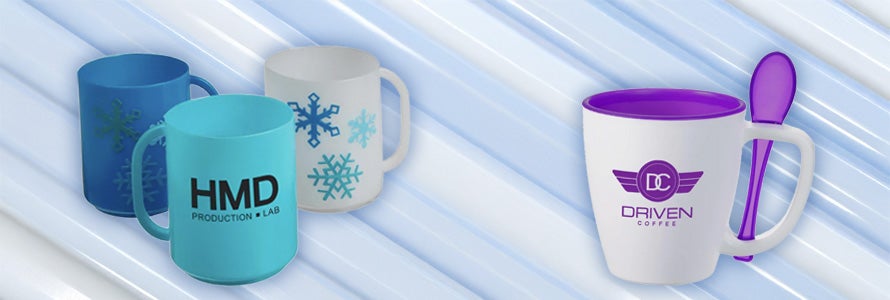
Plastic mugs tend to be made from either acrylic (PMMA) or polypropylene (PP, resin identification code 5). You can find out more about those on our fantastic plastics blog post. Neither of these plastics contain bisphenol-A (BPA), and polypropylene in particular is very heat resistant compared to other plastics.
How It’s Customized
Screen printed, pad printed
Best For
Being inexpensive and unlikely to shatter into sharp pieces if dropped.
Pros
Plastic comes in lots of fun colors and it’s relatively inexpensive. The plastic mugs we tested in our Mug Drop Test cracked but didn’t shatter when dropped from 44”, although one did shatter when dropped from 74.5” onto hard concrete. Because plastic mugs are often made in one piece using injection molding, they tend not to have the same weak spots around the handle join that other mugs have.
Cons
Plastic can be damaged by UV light and heavy use: A lightweight plastic mug is probably not going to last as well as an enamel or ceramic mug long-term. Plus, more people are growing wary about drinking from plastic containers, since there’s some evidence that even plastics that don’t contain BPA can leach other types of microplastics when they come into contact with hot drinks.
Glass
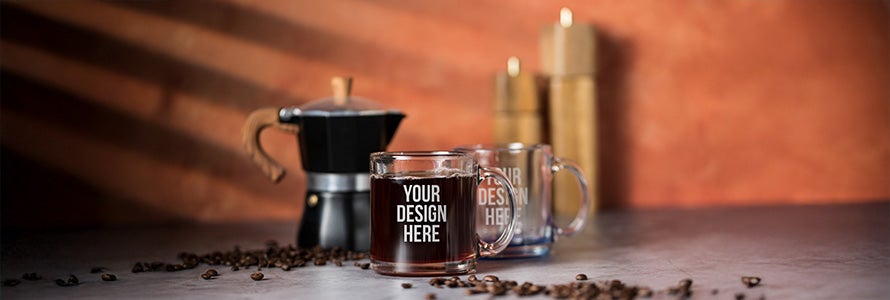
A lot of glassware is made from soda lime glass, but glass mugs intended for hot drinks are often made from borosilicate glass. This contains boron trioxide, which makes the glass less likely to crack in response to temperature swings – key for mugs – and also more durable overall. Glass is technically a type of ceramic, but it gets put in its own category because it has a different molecular structure than other ceramics (amorphous rather than crystalline.)
How It’s Customized
Laser engraved, laser etched, screen printed
Best For
Capturing the perfect latte for the ‘gram.
Pros
Glass mugs really can be super sturdy: Our glass mug didn’t even break when we dropped it from 74.5”! Also, glass mugs look trendy, I don’t make the rules. And while screen prints look great, it’s nice to have the option of having your design etched or engraved into the glass – possibly the most durable kind of imprinting.
Cons
Glass is a little worse at retaining heat than other ceramics – so decide if that’s more important to you than the aesthetic.
Wheat

Wheat? What? That’s right, mugs made of wheat. Well, not wheat, wheat straw, which is a byproduct from wheat harvesting. When you take the lignin out of the wheat straw, break it down using bacteria, and combine it with sugar, you get a natural polymer (as opposed to synthetic polymers like plastics.)
How It’s Customized
Screen printed
Best For
Showcasing your eco-friendly credentials.
Pros
These mugs contain either no plastic or at least less plastic than plastic mugs. In a recent QLP survey, we learned that people really like promos that are labeled eco-friendly, so you might find more takers with wheat mugs than plastic. Plus, our wheat mug survived all of our drop tests (unlike the plastic mugs), so it might actually be stronger than regular plastic mugs – and they cost about the same.
Cons
Often the wheat straw plastic is combined with polypropylene, so it’s not like no synthetic plastic is involved. Although wheat straw plastic on its own is biodegradable, the polypropylene is not. Also, wheat straw plastic can degrade in the dishwasher, but dishwashers are generally bad news for mugs over time, so we shouldn’t hold that against them.
The Bottom Line
Which type of promo mug is best for you depends on your budget, the number of people you’re buying for, the event you’re throwing, and what the youths and Merriam-Webster would call “the vibe” you’re going for. Splurge on laser engraved tumblers for your team, gift your wedding guests laser etched glass mugs, or give away as many ceramic mugs as you can carry at a trade show.
We hope that by the time you’re reading this, you feel much more informed about our different mug materials. (And excited to tell people why enameled mugs are speckled. Maybe this is why I’m never invited on camping trips.)
Natasha Lavender
Natasha is an experienced writer and editor who has covered topics including technology, health and safety, business, and pop culture. Her work has been published by Good Housekeeping magazine, Forbes, Success, and more.