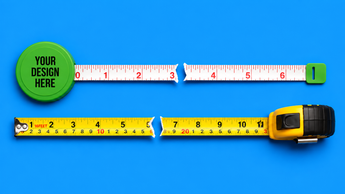
How Durable Are Promotional Tape Measures?

On September 17th, 2026
7 Minute Read
The most effective marketing is personalized. We experience this most often on social media – blame Meta for your ever-growing collection of Star Wars-themed novelty shirts – but it extends…
We wanted to know how much mileage our promo pens give us – literally: how many miles can each pen write for? So we used a custom machine designed to…
Glow in the dark gives your giveaways something a little extra to grab attention – but is it just a gimmick? A bunch of our promo products come with a…
has more to offer than just awesome blog posts! Check out our selection of custom coffee mugs, t-shirts, pens, water bottles, and more. If you can dream it, we can print a design on it!
You’ll find 30,000 unique products on our site, all waiting for you to customize them with a logo, text, or artwork. Whether you need personalized wedding favors, promotional swag for a trade show, or small gifts for a class reunion, we’ve got your back!
The best part is every order is fast, easy, and above all, fun. You’ll work one-on-one with your very own sales rep who will be your go-to person from the start to the end of your order. No annoying robots, because let’s face it, nobody likes hearing those on the phone. Did we mention that we offer on-time delivery or your money back? In fact, your order may just come BEFORE your deadline. Speed is our middle name!
So if you’re ready to get started, give us a call 1-866-312-5646 or send us an email at info@qualitylogoproducts.com.
When you see a water bottle or tumbler labeled “double-walled vacuum-sealed,” those aren’t just buzzwords. These water bottles are like the special forces of water bottles. We can probably thank…
When we talk about our hottest products or the coolest promos, we have to mention hot/cold packs. They’re great for cooling down on a hot day, or vice versa, and…
Fonts make a big difference to your reading experience, especially in a small space. Most of our pens have a maximum imprint size of around 2” W x 0.5” H.…
This is a safe space to admit that you’ve never really thought that much about pens or pen-related terminology. If you don’t know the difference between a rollerball and a…
Dropping a laptop on a hard floor is an expensive mistake. Could a promo laptop case save your customers from such a stomach-lurching moment – and forever endear you to…
When your customers work tough hands-on jobs, the promo products you give them need to keep up. “If they get something that’s poorly made – that they know won’t last…
We like to keep you up to date with upcoming features at QLP, and we’ve recently added one we’re particularly proud of. It’s called the Customer Portal, and it’s where…
We’re generally pretty easy-going people until we hear someone spreading misconceptions about promo products. Even then, we mostly just ask them to read this blog post that busts some of…
When you have a design that’s simply too good to contain to one part of a product, you need all-over printing. We do all-over printing on a wide range of…
We like snacks almost as much as we like testing our products, so it was inevitable that our bag clips would end up in a QLP test at some point.…
The key to remembering new information is to write it down – which makes notebooks a very memorable giveaway. Not all notebooks are created equal. We’re going to explain the…
We hope ordering giveaways is one of your favorite parts of organizing your trade show booth. However, we’re biased, and we know it can also feel like a lot of…
We make your logo look so good on glassware and mugs that you’ll want them to last forever. Does that mean keeping them out of the dishwasher? As much as…
What do mouse pads, novelty erasers, and sticker sheets have in common? They all make great promos, yes, and they’re all made using die cutting! Despite the confusing name (no…
Good things come in mini sizes, especially when those things are buckets. When hardware store Lowe’s put out pint-sized versions of its plastic buckets in October 2024, TikTok took note.…
While cut flowers are a nice traditional gift, they tend to last about five minutes and it’s hard to print a logo on a petal. Enter a better option: Seeded…
Make no mistake, we think our erasers are great – and we’re here to prove it. Yes, our erasers look cool and all that space for your design makes them…
Did you drink water today? And more importantly, did you drink it from a Stanley cup? Once most likely to be spotted in your grandpa’s work bag, Stanley cups hit…
Promo magnets are mini billboards your customers see every day – but do they hold up to scrutiny? Magnets are a great giveaway choice. They lie flat so all your…
Holiday ornaments are made by Santa, the end. That’s not true, and frankly that guy gets enough credit for Christmas already. That was just in case any kids are reading…
Your favorite coffee mug is a feat of engineering. People have been making mugs since the first person got tired of walking to the nearest stream every time they wanted…
has more to offer than just awesome blog posts! Check out our selection of custom coffee mugs, t-shirts, pens, water bottles, and more. If you can dream it, we can print a design on it!
You’ll find 30,000 unique products on our site, all waiting for you to customize them with a logo, text, or artwork. Whether you need personalized wedding favors, promotional swag for a trade show, or small gifts for a class reunion, we’ve got your back!
The best part is every order is fast, easy, and above all, fun. You’ll work one-on-one with your very own sales rep who will be your go-to person from the start to the end of your order. No annoying robots, because let’s face it, nobody likes hearing those on the phone. Did we mention that we offer on-time delivery or your money back? In fact, your order may just come BEFORE your deadline. Speed is our middle name!
So if you’re ready to get started, give us a call 1-866-312-5646 or send us an email at info@qualitylogoproducts.com.

Shop Top Promotional Products at qualitylogoproducts.com